

Tuning Box vs Remap on Locked ECUs – What Are Your Options in 2026?
“`html
Modern cars are becoming increasingly difficult to tune through the traditional ECU remapping route.
Manufacturers now use increasingly sophisticated software protection, security and authentication on their Engine Control Units (ECUs). On some vehicles this means a conventional remap can no longer simply be carried out through the diagnostic port in the way it once could.
That does not mean modern cars cannot be tuned.
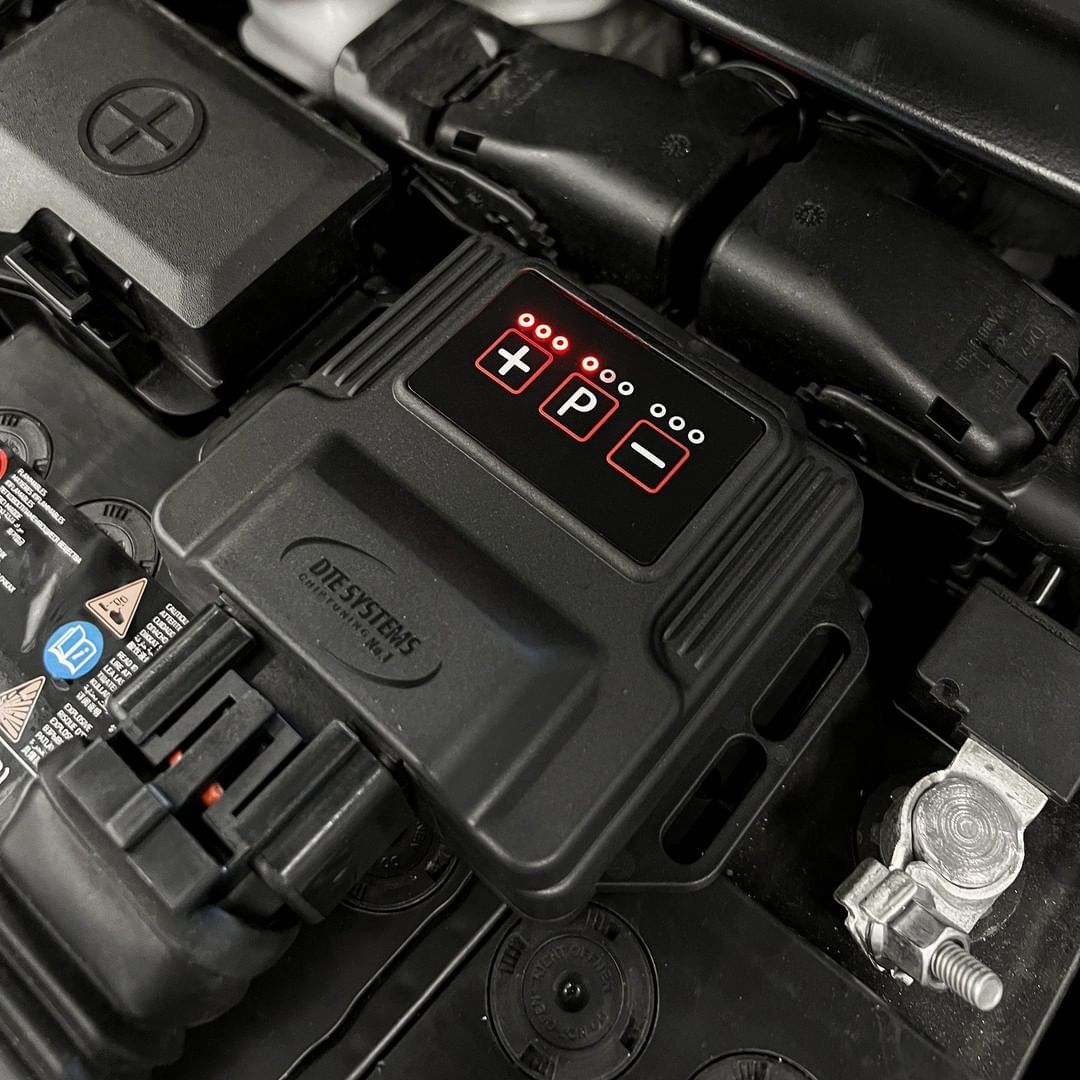
Instead, owners may now have several very different options depending on the vehicle: an ECU unlock followed by remapping, a manufacturer-level or factory calibration upgrade on certain models, or an external plug & play tuning system such as a DTUK tuning box.
Understanding the difference between these methods is becoming increasingly important.
Why are modern ECUs harder to remap?
A conventional ECU remap changes the software calibration stored inside the vehicle’s Engine Control Unit.
To do that, a tuning tool first needs sufficient access to read, unlock or write to the ECU.
On many modern vehicles, manufacturers use technologies including:
- Encrypted ECU memory
- Software authentication
- Digital signatures
- Secure boot processes
- Protected communication protocols
- Additional anti-tamper measures
These systems can prevent ordinary aftermarket equipment from simply reading and rewriting the ECU.
As a result, a vehicle that may once have been remapped through the diagnostic port can now require considerably more work before its software can be modified.
Does a locked ECU mean a car cannot be remapped?
No.
This is an important distinction.
A protected or locked ECU does not necessarily mean that remapping is permanently impossible. It means that access to the ECU may be restricted until a compatible unlocking method becomes available.
Depending on the vehicle and ECU, a modern remapping process may involve:
- Removing the ECU from the vehicle
- Unlocking the ECU using specialist equipment
- Sending the ECU to a specialist unlocking service
- Reading and writing the ECU on the bench rather than through the diagnostic port
- Using specialist hardware and software developed specifically for that ECU
New unlocking solutions are continually being developed, so a vehicle that could not be conventionally remapped a year ago may have a remapping solution available today.
A real example: the modern Defender 3.0 Ingenium diesel
The 3.0-litre Ingenium diesel used in modern Jaguar Land Rover vehicles is a good example of how quickly the tuning market can change.
The Defender D200, D250, D300 and D350 use Bosch MD1-series engine management which, for a considerable period, significantly restricted conventional aftermarket ECU tuning.
This resulted in several different approaches appearing in the market.
Some Jaguar Land Rover specialists offered factory-level software or configuration upgrades that could move compatible lower-output vehicles towards a higher factory power specification, such as converting certain D300 vehicles towards D350 specification.
That is not quite the same thing as a conventional aftermarket remap. Instead of creating a completely new custom calibration, the process uses manufacturer-level software or configuration to access an existing higher-output factory specification where compatible.
More recently, new ECU unlocking technology has also made genuine aftermarket read/write access possible on compatible Bosch MD1CP007 ECUs used by D200, D250, D300 and D350 3.0 Ingenium diesel vehicles.
On these vehicles, the process can require the ECU to be unlocked before it can subsequently be read and written using bench equipment.
So today there can be three distinctly different routes:
- A factory or OEM-level power configuration change
- An ECU unlock followed by an aftermarket remap
- An external plug & play tuning box
They should not be confused with one another.
What is the difference between a tuning box and an ECU remap?
The fundamental difference is where the performance calibration takes place.
ECU remap
An ECU remap modifies the calibration stored within the vehicle’s original engine control software.
Depending on the vehicle, this may be carried out through the diagnostic port, directly on the ECU or after an ECU unlocking procedure.
Once written, the new calibration becomes part of the ECU software until it is changed or returned to standard.
DTUK tuning box
A DTUK tuning box takes a different approach.
It is an external performance module that works alongside the vehicle’s existing engine management system.
The system connects to the relevant engine sensors for the individual vehicle application and adjusts those signals according to the DTUK calibration.
The original ECU software itself is not rewritten.
This means there is no need to read, modify or overwrite the original engine map in order to install the DTUK system.
Why can a tuning box work when ECU access is restricted?
Because a DTUK tuning box does not need to rewrite the ECU software, it does not rely on gaining the same type of access required for a conventional remap.
The vehicle’s ECU remains in place and continues to operate using its original software.
The DTUK module works externally with the relevant sensor information and allows the original ECU to remain responsible for overall engine management.
This makes the tuning-box approach particularly useful on newer vehicles where direct ECU access may be difficult, expensive or require additional unlocking procedures.
Is a tuning box better than a remap?
There is no single answer that is correct for every vehicle or every owner.
A properly developed ECU remap can offer considerable flexibility because the calibration inside the ECU itself can be modified.
A high-quality tuning box has different advantages, particularly for an owner who values removability and does not want the original ECU software rewritten.
The better question is therefore not simply:
“Which gives more power?”
It is:
“Which tuning method best suits this particular vehicle and the way I intend to use it?”
Advantages of a DTUK plug & play tuning box
- No ECU software rewrite – the original engine calibration remains in the ECU.
- Removable – the tuning system can be removed and the vehicle returned to its original configuration.
- No ECU unlocking procedure – installation does not require the ECU to be removed and unlocked for remapping.
- Vehicle-specific installation – compatible DTUK systems use application-specific wiring and connectors.
- Adjustability – compatible systems provide different programmes and fine-tuning settings.
- App control – selected DTUK systems can be controlled using the DTUK smartphone app.
- Transferability – in some cases the hardware can be reprogrammed and used on another compatible vehicle with the appropriate wiring.
What are the advantages of an ECU remap?
A conventional ECU remap gives the tuner direct control over the software calibration inside the engine management system.
Where full access is available, this can allow a specialist to alter a wider range of calibration tables and tailor the software around a particular vehicle or requirement.
For some owners and some vehicles, that may be the preferred approach.
However, on modern protected ECUs there may be additional steps involved before that calibration can be changed, including ECU removal, unlocking or bench programming.
Factory power upgrades are not necessarily the same as remapping
This is particularly relevant on vehicles where manufacturers sell several power outputs based on closely related engine platforms.
Some specialists with access to manufacturer-level systems can offer upgrades based on a higher-output factory calibration.
For example, certain Jaguar Land Rover 3.0 Ingenium diesel applications may be eligible for factory-level configuration changes between D200, D250, D300 and D350 specifications.
Where available, this is fundamentally different from an aftermarket tuner creating and writing their own Stage 1 calibration.
Owners should therefore ask exactly what is being offered:
- Is it a genuine aftermarket remap?
- Is the ECU being unlocked first?
- Is an existing manufacturer calibration being activated?
- Or is an external tuning module being installed?
The word “remap” is sometimes used very loosely, despite the underlying processes being quite different.
What happens if an ECU unlocking solution becomes available later?
This is another reason why saying a modern vehicle “cannot be remapped” can be misleading.
ECU security is an evolving area.
Specialist tuning-tool manufacturers continually develop new access and unlocking methods. When a new protocol becomes available, vehicles that previously had little or no aftermarket ECU access can suddenly become tunable.
The modern Jaguar Land Rover 3.0 Ingenium platform is a good example of this.
It is therefore more accurate to say that a particular ECU may be currently unsupported or require specialist unlocking rather than claiming it can never be remapped.
What about manufacturer warranty?
Any aftermarket performance modification should be considered carefully where a vehicle remains under manufacturer warranty.
A tuning box has the advantage of being removable and does not require the original ECU calibration to be overwritten.
That does not mean that any aftermarket modification can be guaranteed to have no effect on a warranty claim.
A manufacturer or warranty provider may investigate modifications if they believe those modifications contributed to a particular failure.
Customers should also inform their insurance provider of relevant vehicle modifications.
The important distinction with the DTUK approach is that the original ECU software itself has not been replaced with an aftermarket calibration.
Can a tuning box damage or corrupt the ECU?
A DTUK tuning box does not flash or rewrite the ECU software, so installation does not involve the type of ECU-writing process associated with remapping.
This removes the possibility of a failed software-writing operation during installation.
As with any performance modification, however, product quality, correct application selection, installation and calibration are important.
This is why DTUK systems are developed for specific engine applications rather than being sold as universal performance modules.
Can I remove the tuning box and return the vehicle to standard?
Yes.
A key advantage of the DTUK approach is reversibility.
The module and vehicle-specific wiring can be removed, after which the engine once again operates using the original sensor connections and original ECU software.
This can be particularly attractive to customers who lease vehicles, change cars regularly or simply want the option of returning the vehicle to its original configuration.
Locked ECU vs tuning box: which route makes sense?
If your vehicle has an ECU that can be easily and safely remapped, both a quality ECU remap and a quality tuning box may be viable options.
If the ECU requires removal, specialist unlocking or additional bench work, the practical differences become greater.
A DTUK tuning box can provide a simpler alternative where:
- You do not want the original ECU software rewritten
- You want the modification to remain removable
- You do not want the ECU removed for an unlocking procedure
- You want adjustable programmes or compatible app control
- You may want to return the vehicle to standard later
Equally, an owner who specifically wants a fully customised ECU calibration may decide that an ECU unlock and remap is the more appropriate route.
Modern ECU tuning is changing quickly
The important lesson is that the tuning market is no longer as simple as “tuning box versus remap”.
Modern vehicle security has created several different routes to additional performance.
Some cars can still be remapped conventionally. Others require an ECU unlock first. Some platforms can use higher-output manufacturer calibrations. Others may have no practical ECU tuning solution available yet.
A plug & play tuning box operates independently of that ECU-access race because it does not require the original engine software to be rewritten.
That is why external tuning systems remain particularly relevant as vehicle manufacturers introduce increasingly protected engine management systems.
Choosing the right tuning option for your car
Before choosing any performance upgrade, establish exactly what is available for your particular vehicle, engine, ECU and production year.
Do not assume that because one version of an engine can be remapped, every model year or ECU version can be treated in exactly the same way.
Likewise, always select a tuning box using the exact vehicle application rather than simply choosing a product based on engine capacity or advertised power.
DTUK has specialised in vehicle-specific plug & play performance systems since 2005 and offers applications for a wide range of modern petrol, diesel and hybrid vehicles.
For owners of modern Defender models, you can also read our dedicated guide:
Defender D200, D250, D300 & D350 3.0 Ingenium Diesel Tuning
Or use the DTUK vehicle selector to find the correct tuning system for your exact car.
“`